

In the thrilling world of online casinos, the stakes are high, and peace of mind is priceless. Every player deserves a fair shot, but navigating the digital landscape to find truly trustworthy casinos can feel like a gamble in itself. Are the games truly random? Is the house edge honest? These are valid concerns, and understanding how to identify fair platforms is essential for a positive and secure gaming experience.
This guide is designed to empower you with the knowledge to discern genuine online casino fairness. Forget relying solely on luck; we’ll equip you with the tools to assess a casino’s commitment to fair play. We will explore the three pillars that underpin online casino fairness: rigorous Random Number Generator (RNG) audits that ensure unpredictable outcomes, the weight of regulatory oversight from respected gambling authorities, and the revolutionary concept of provably fair systems that put the power of verification directly in your hands. By understanding these cornerstones, you can confidently choose online casinos that prioritize integrity and offer a level playing field.
Decoding Casino Licenses and Regulatory Bodies
A casino license is more than just a piece of paper; it’s a casino’s commitment to fair play, security, and responsible gambling. Think of it as a seal of approval, indicating that the casino adheres to specific standards and regulations. Without a valid license, a casino operates in a legal gray area, leaving players vulnerable to unfair practices.
Several regulatory bodies worldwide ensure casinos play by the rules. These gambling commissions set stringent requirements that casinos must meet to obtain and maintain their licenses. Here are a few key players:
- UK Gambling Commission (UKGC): Renowned for its rigorous standards, the UKGC oversees gambling operations in the United Kingdom. Casinos licensed by the UKGC are considered highly reputable, as they must demonstrate financial stability, implement robust security measures, and adhere to strict player protection policies. Look for the UKGC logo usually in the website’s footer.
- Malta Gaming Authority (MGA): The MGA licenses and regulates online casinos worldwide. Malta was one of the first countries to regulate online gambling and offers a robust framework for operators. MGA-licensed casinos must comply with anti-money laundering regulations and ensure fair gaming practices.
- Curacao eGaming: Curacao eGaming is one of the oldest and most established iGaming regulators. While it historically had a reputation for being less stringent than the UKGC or MGA, it has been upgrading its standards in recent years by adding more requirements for operators. A Curacao license, while common, requires careful consideration by players.
When choosing an online casino, always check for licensing information, which is typically found in the website’s footer. A legitimate license from a reputable regulatory body provides a layer of security and accountability, ensuring a fairer and safer gambling experience. If a casino doesn’t display its licensing information clearly or if the license seems dubious, it’s best to steer clear.
Red Flags: Spotting Unfair Practices
Navigating the world of online casinos can be exciting, but it’s crucial to stay vigilant and recognize potentially unfair practices. Protecting yourself means knowing what to watch out for. Here are some key red flags that should raise your suspicion:
- Unclear or Confusing Terms and Conditions: A common tactic of unfair casinos is to bury unfavorable rules deep within complex terms and conditions. If the language is difficult to understand or contradicts itself, proceed with caution. Reputable casinos have transparent and easily accessible terms. Action: Scrutinize the terms carefully before depositing any money. If anything seems ambiguous or unfair, consider playing elsewhere.
- Overly Aggressive Marketing and Spam: While promotions are common, a barrage of unsolicited emails or aggressive pop-up ads could signal a casino desperate for players. This might indicate financial instability or a willingness to engage in unethical marketing practices. Action: Be wary of casinos that bombard you with promotional offers. Unsubscribe from their mailing list and consider it a general warning sign.
- Consistently Delayed or Denied Payouts: One of the most blatant red flags is difficulty withdrawing your winnings. Unfair casinos might invent excuses for delays, impose unreasonably low withdrawal limits, or even outright deny payouts. I recall a personal experience where I won a modest sum, only to face weeks of stalling tactics and ultimately, a refusal to pay, citing a vague violation of their bonus terms – which, of course, they couldn’t specify. Action: Document all communication with the casino. If payouts are consistently delayed or denied without a valid reason, stop playing immediately and consider reporting them to a gambling authority.
- Lack of Transparency and Licensing Information: Legitimate online casinos operate under licenses from reputable regulatory bodies. They prominently display their licensing information on their website. A lack of transparency about ownership, location, or licensing is a major red flag. Action: Verify the casino’s licensing information with the relevant regulatory body. If they aren’t licensed or the information is missing, avoid them.
- Unresponsive or Unhelpful Customer Service: Reliable customer support is essential. A casino that ignores your inquiries or provides unhelpful, generic responses is likely to be problematic in other areas as well. Action: Test the customer service before you deposit any money. Ask a question and see how quickly and effectively they respond. Poor customer service is a sign of deeper issues.
- Suspicious Bonus Terms and Conditions: Bonuses can be attractive, but they often come with strings attached. Unfair casinos may have wagering requirements that are nearly impossible to meet or impose maximum withdrawal limits on bonus winnings that render the bonus essentially worthless. Action: Read the bonus terms carefully before claiming any offer. Pay close attention to wagering requirements, maximum withdrawal limits, and any other restrictions.
By being aware of these red flags and acting accordingly, you can minimize your risk and enjoy a safer, more enjoyable online casino experience.
The Transparency Paradox
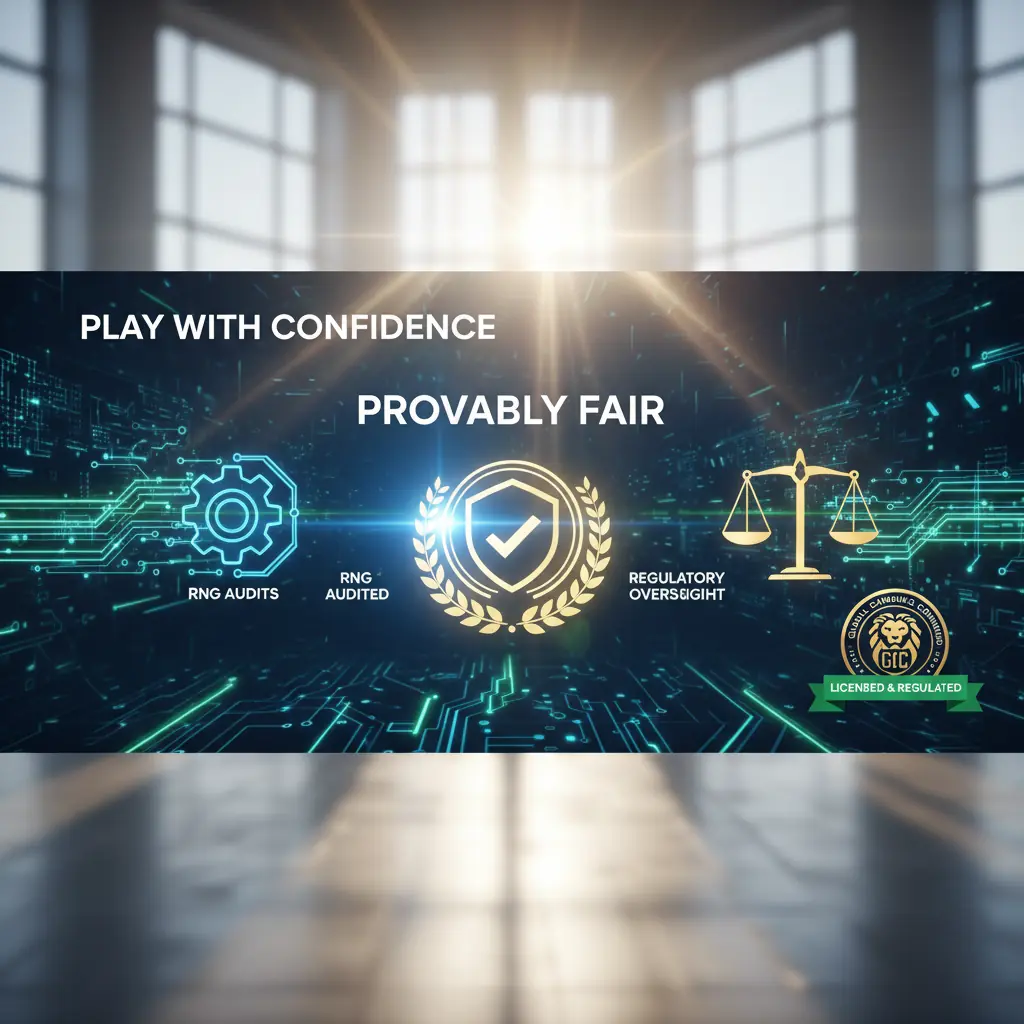
Modern digital systems, especially those powering online casinos, generate unprecedented amounts of data. Yet, paradoxically, the intricate logic governing these systems often remains invisible to the user. This ‘black box’ effect creates a transparency paradox: while data abounds, understanding the mechanisms that drive outcomes is obscured. In the world of online gambling, where trust is paramount, this opacity presents a significant challenge.
Fairness isn’t just an ethical consideration; it’s the bedrock of commercial viability. No player will wager their money if they suspect the game is rigged. To address this, the online gambling architecture rests on three pillars: RNG Auditing, Regulatory Oversight, and Data Integrity. These components converge to ensure a fair playing field, safeguarding the interests of both the operator and the consumer, ultimately building a sustainable and trustworthy online environment.
Understanding Random Number Generators (RNGs)
At the heart of every fair casino game, be it online or in a brick-and-mortar establishment, lies the random number generator, or RNG. Think of it as the behind-the-scenes engine ensuring true randomness. Without it, the thrill of chance would simply vanish. An RNG is basically an algorithm, a set of instructions that spits out numbers in an unpredictable sequence. In casino games, this is critical. For example, when you spin the reels on a slot machine, the RNG is working furiously, generating thousands of numbers every single second. Each of these numbers corresponds to a specific combination of symbols on the reels. The outcome you see is directly linked to the number the RNG produced at that precise instant.
Here’s the real kicker: Each spin is entirely independent. The RNG doesn’t remember the previous spin, nor does it anticipate the next. It’s a clean slate every single time. This is what guarantees fairness. Without an RNG, either the player or the casino could potentially manipulate the game to their advantage. While these RNGs are technically pseudo-random (meaning they follow a complex but deterministic algorithm), the sequence is so intricate and the starting point so unpredictable that, for all practical purposes regarding the user experience, the results are indistinguishable from true randomness.
RTP (Return to Player) and House Edge
Now, let’s talk about RTP, or Return to Player. Imagine you’re playing a slot machine. The RTP is the percentage of all wagered money that the slot machine is expected to pay back to players over a very long period of time. So, if a slot has an RTP of 96%, it theoretically returns $96 for every $100 wagered. Important note: this is not a guarantee! You won’t necessarily win $96 every time you bet $100. RTP is calculated over thousands, even millions, of spins.
The house edge is simply the opposite of the RTP. It’s the casino’s profit margin on a particular game. Using the previous example, if a slot has a 96% RTP, the house edge is 4% (100% – 96% = 4%). This 4% represents the casino’s expected profit from that game over the long run. Visual representation: think of a pie chart. If the whole pie is 100%, the RTP is a big slice, and the house edge is the remaining, smaller slice.
The Role of Independent Audits
To ensure fairness and integrity in the online casino world, independent audit firms play a vital role. These organizations conduct rigorous testing and certification of online casino games, verifying that they operate as intended and provide players with a fair chance of winning.
Companies like eCOGRA (eCommerce Online Gaming Regulation and Assurance), iTech Labs, and Gaming Laboratories International (GLI) are the big names in this space. They specialize in evaluating Random Number Generators (RNGs), which are the heart of any online casino game. The RNG determines the outcome of each spin, card draw, or dice roll, making sure the results are truly random and unbiased.
The audit process involves extensive testing of the RNG to confirm its randomness and unpredictability. They also verify the accuracy of the Return to Player (RTP) percentage, which indicates the amount of money a game is expected to pay back to players over time. Auditors analyze game performance, looking for any glitches or vulnerabilities that could be exploited.
Developers and operators must pass these audits to gain certification. Once certified, the games usually receive a digital seal of approval or license. These seals are often displayed in the footer of casino websites. Players can usually click on a seal to verify its authenticity and confirm that the games have been properly tested.

Provably Fair Systems: A New Era for Crypto Casinos
Provably fair systems are revolutionizing crypto casinos by offering a level of transparency and trust previously unheard of in online gambling. Utilizing cryptography, these systems empower players to independently verify the fairness of each game outcome. Unlike traditional online casinos where the house holds all the cards—and the algorithms are hidden—provably fair systems put the power of verification directly in the player’s hands. This cryptographic verification ensures that neither the casino nor any third party can manipulate the results in their favor.
The magic behind provably fair systems lies in a handful of cryptographic building blocks working in harmony to generate and lock in results. This typically involves components like a server seed (controlled by the casino), a client seed (provided by the player), and a nonce (a unique number incremented with each bet). A hash commitment scheme further guarantees the integrity of the server seed. Before a game starts, the hashed server seed is revealed to the player. After the game, the unhashed server seed is unveiled, allowing the player to independently check that it matches the original hash. By combining these elements, provably fair systems create a transparent and verifiable record of each game’s outcome, giving players peace of mind.
On-Chain RNGs and Smart Contracts
Blockchains are inherently deterministic, meaning that given the same input, they will always produce the same output. This presents a challenge for generating truly random numbers, essential for casino games. That’s where on-chain Random Number Generators (RNGs) and smart contracts come into play. Smart contracts are self-executing agreements written into the blockchain’s code. To overcome the deterministic nature of blockchains, these smart contracts often rely on external sources of randomness, sometimes referred to as decentralized oracles, to introduce entropy and reshape fairness. These oracles provide unpredictable data that is then used to generate random numbers within the smart contract.
Beyond the Technology: The Human Element of Fair Play
While Random Number Generators and RTP percentages are critical for fair casino gaming, the human element of customer service and dispute resolution is equally vital. Even the most sophisticated technology can be undermined by unresponsive or unfair casino support. When players encounter issues, they need to be able to rely on the casino to address their concerns promptly and impartially.
Good customer service means being readily available through multiple channels, such as live chat, email, and phone. Representatives should be knowledgeable, helpful, and empowered to resolve problems efficiently. Conversely, bad customer service includes long response times, unhelpful or dismissive attitudes, and a reluctance to investigate player complaints thoroughly.
When casinos fail to cooperate in resolving disputes, players have alternative options. Approaching the gambling commission that issued the casino’s license is a common step. In extreme cases, legal action may be necessary to ensure fair play and protect players’ rights.
Conclusion
Navigating the world of online casinos requires a keen eye and a discerning mind. As you’ve learned, factors like RNG audits, regulatory oversight, and the presence of provably fair systems are crucial indicators of an online casino’s commitment to fairness. These aren’t just buzzwords; they are the cornerstones of a trustworthy gambling environment.
You now possess the knowledge to differentiate between casinos that prioritize fair play and those that might be less scrupulous. Embrace this knowledge and demand transparency. Don’t settle for anything less than a fair chance. After all, fairness in online gaming isn’t a privilege – it’s a right. Use your newfound awareness to choose wisely and enjoy your gaming experience with confidence, knowing you’ve made an informed decision.